

Professional support

Counsellor's corner.

A slowly-growing collection of resources for grievers considering professional support, and for clinicians who work with the bereaved.

Vintage television with a pair of canvas sneakers resting on top

Ask the counsellor

Bring your question.

Write what is on your heart. A grief counsellor will read it and write back. You choose whether your question stays private between us, or whether it might be gently anonymised and shared so others walking a similar path can find comfort.

Privacy

We aim to reply within 5 working days. Every question is read with care.

If you are wondering whether to see someone

There is no rule about when grief is 'enough' to warrant professional support. If you are wondering, that is reason enough. A grief counsellor or therapist is not there to make you 'better'. They are there to walk beside you, with skill and patience, while you find your own steady ground.

Look for someone who specifies grief and bereavement as part of their practice. Ask for a short introductory call. Trust your gut on fit. It is permitted to try one and then try another.

Grief asks a great deal of the people living it, and of the people who sit beside it, too.

This is a growing collection of practice notes, recommended reading, useful frameworks and thoughtful resources for counsellors, professionals and anyone wanting to better understand grief. We explore continuing bonds, traumatic loss, difficult conversations, the language of grief, and the words that can help, as well as the ones that often don't.

For those who are grieving, there is space here to better understand what you may be experiencing, to find language for what can feel impossible to explain, and to know that there is no single right way to carry your loss.

For those supporting someone, there is guidance for showing up with greater understanding, without trying to hurry, solve or make sense of what cannot be fixed.

For those grieving, a place to feel understood.
For those beside them, a place to learn how to stay.

A small guide, to share

When a Child Is Grieving

A gentle guide for helping children navigate the loss of someone they love, written by play therapist and registered counsellor Caitlin Kennedy.

Download PDF

Hands cupping a small lit candle, warm amber light

A small guide, to share

A Permission Slip

Some days, grief needs permission more than advice. This is a gentle reminder of all the things you are allowed to feel and be while you grieve.

Download PDF
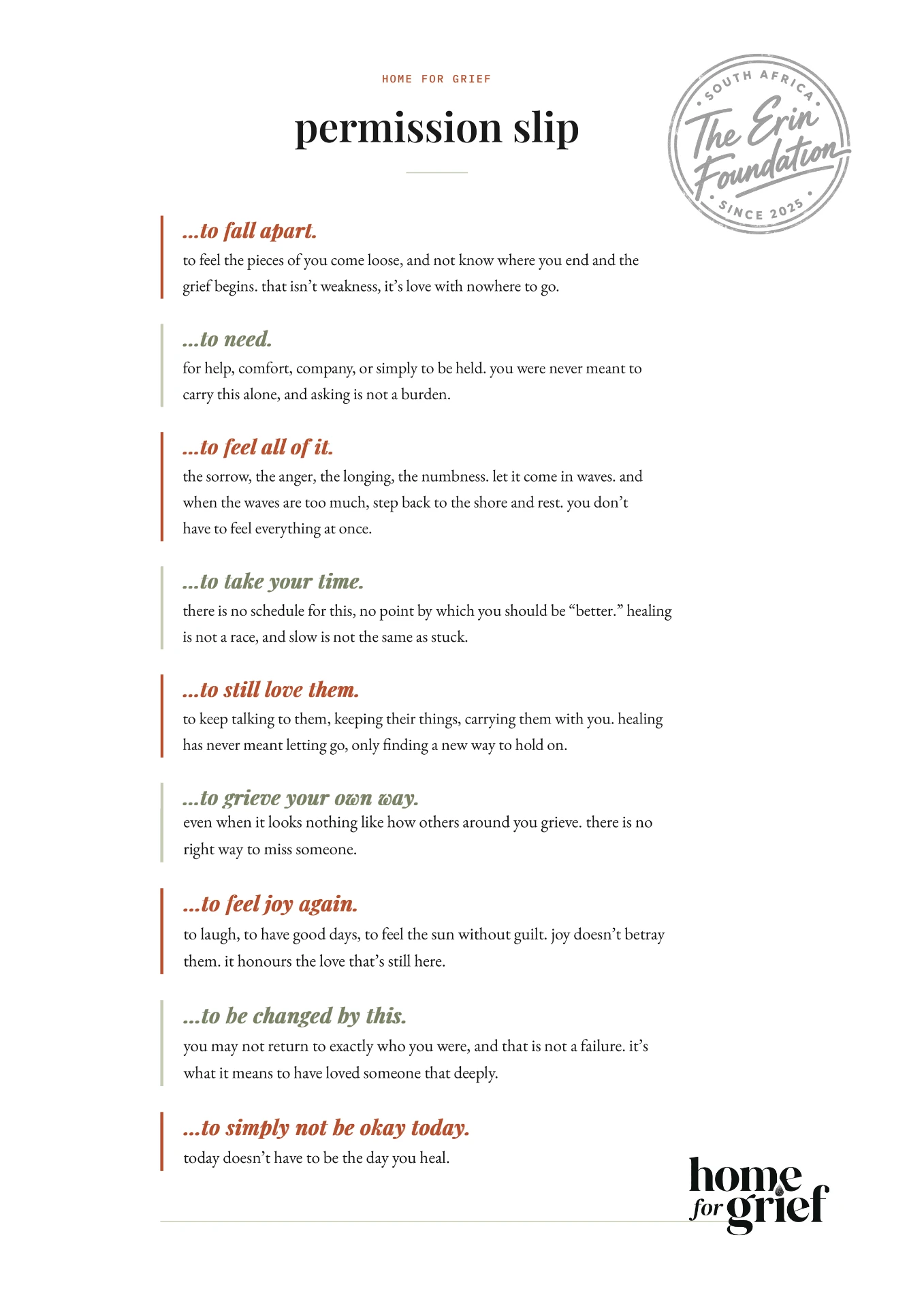
A Permission Slip from Home for Grief, in deep indigo with torn-paper strips. It grants permission: to fall apart, because that is not weakness but love with nowhere to go; to need help, comfort and company, because you were never meant to carry this alone; to feel all of it (sorrow, anger, longing, numbness) and to rest when the waves are too much; to take your time, because healing is not a race and slow is not the same as stuck; to still love them and find a new way to hold on; to grieve your own way, because there is no right way to miss someone; to feel joy again without guilt, because joy honours the love still here; to be changed by this; and to simply not be okay today.

A small guide, to share

Coping with Grief

There is no right way to grieve, but there are gentle things that can help you carry it. These are small, kind ways to tend to yourself.

Download PDF
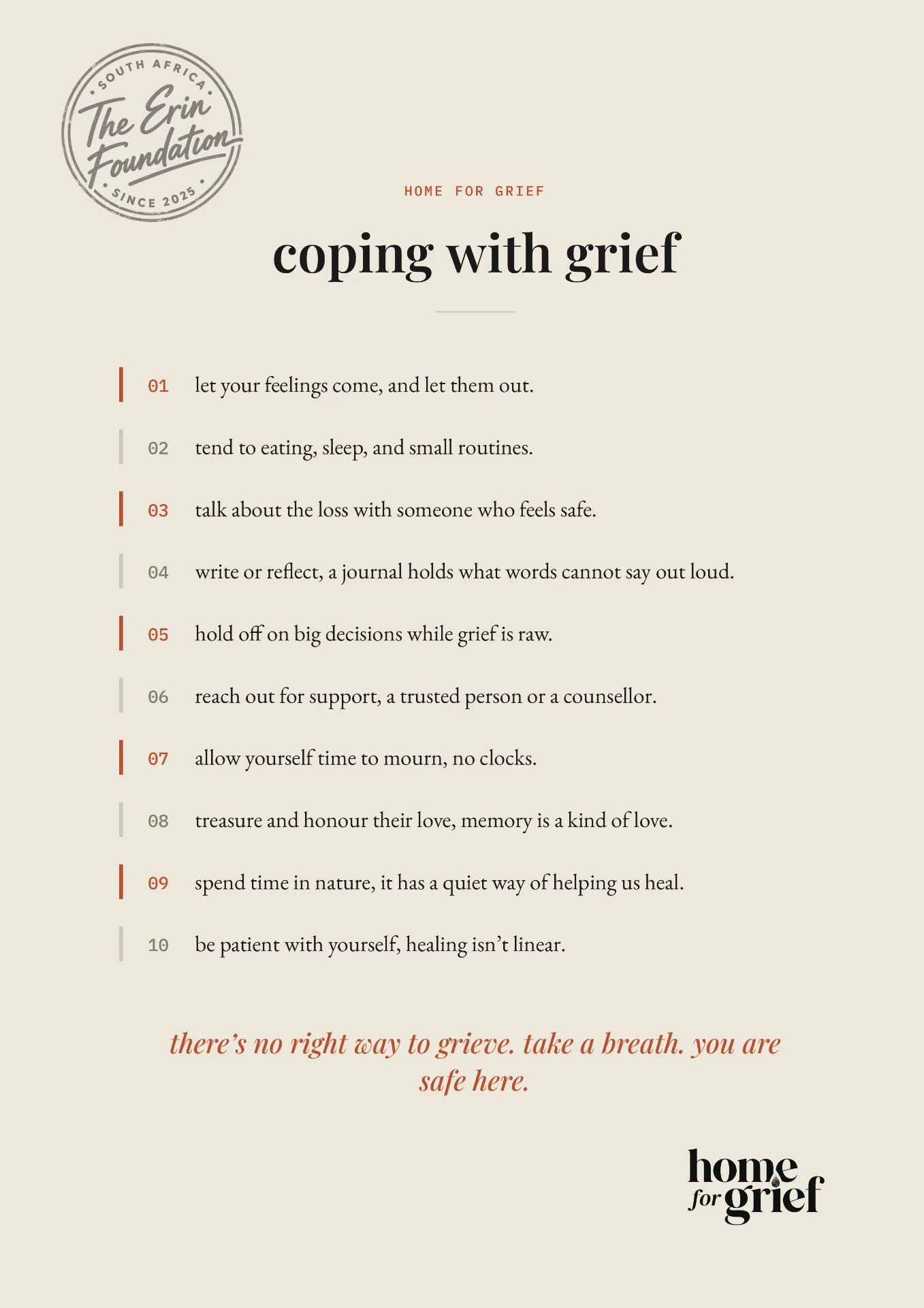
An infographic titled 'Coping with Grief,' from Home for Grief, with ten numbered suggestions arranged in a circle. One: let your feelings come and let them out. Two: tend to eating, sleep and small routines. Three: talk about the loss with someone who feels safe. Four: write or reflect, as a journal holds what words cannot say out loud. Five: hold off on big decisions while grief is raw. Six: reach out for support, a trusted person or a counsellor. Seven: allow yourself time to mourn, with no clocks. Eight: treasure and honour their love, because memory is a kind of love. Nine: ease off alcohol and other ways of numbing the pain. Ten: be patient with yourself, because healing isn't linear. It closes: there's no right way to grieve. Take a breath. You are safe here.

A small guide, to share

Grief Burnout

When you have been carrying grief and daily life for a long time without rest, exhaustion can creep in quietly. These are some of the ways grief burnout can show up, in the body, the heart and mind, and daily life.

Download PDF
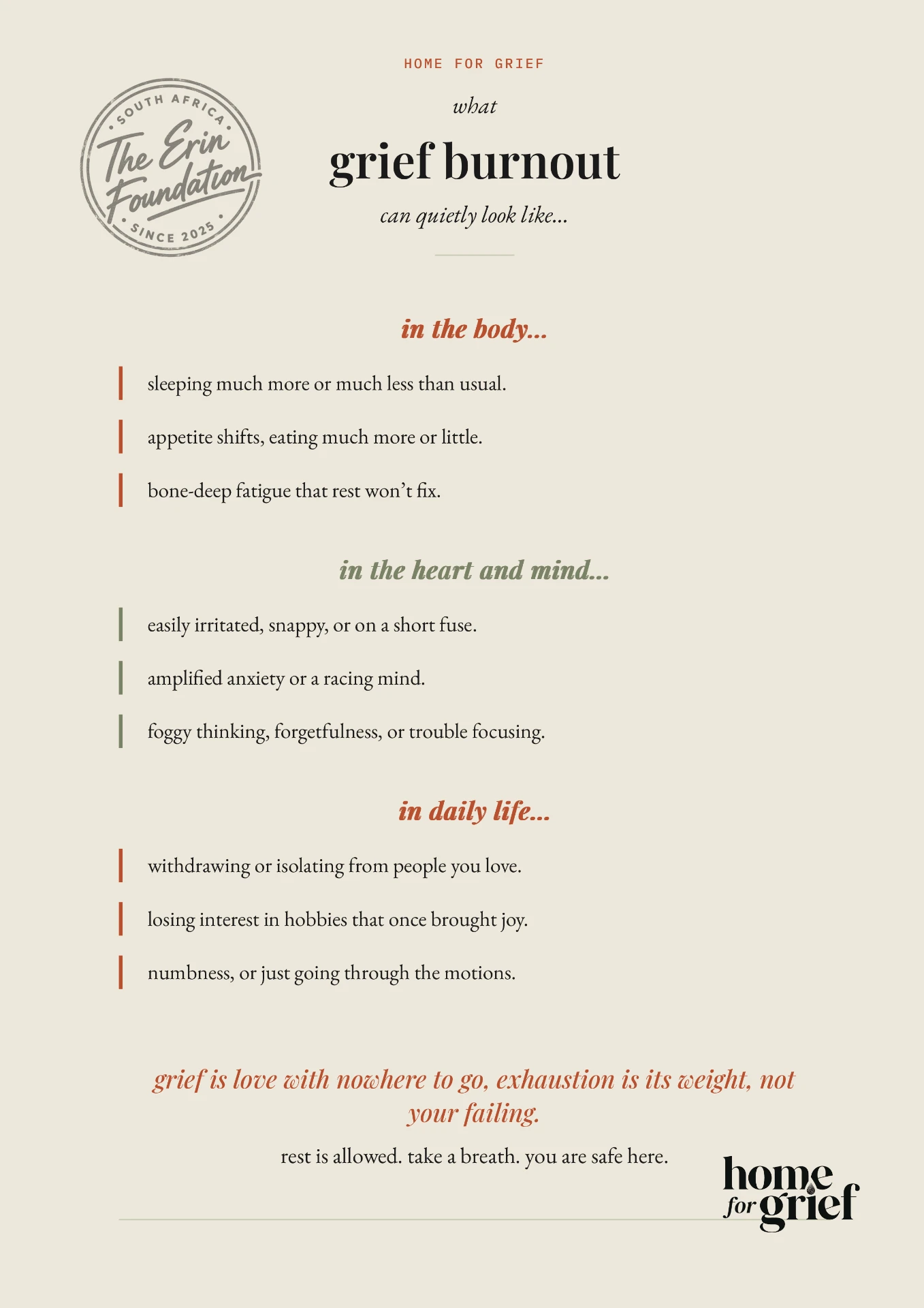
An infographic titled 'What grief burnout can quietly look like,' from Home for Grief. In the body: sleeping much more or much less than usual; appetite shifts, eating much more or little; bone-deep fatigue that rest won't fix. In the heart and mind: easily irritated, snappy or on a short fuse; amplified anxiety or a racing mind; foggy thinking, forgetfulness or trouble focusing. In daily life: withdrawing or isolating from people you love; losing interest in hobbies that once brought joy; numbness or just going through the motions. It closes: grief is love with nowhere to go, exhaustion is its weight, not your failing. Rest is allowed. Take a breath. You are safe here.

A small guide, to share

Things No One Tells You About Grief

Grief holds many surprises that few people warn you about. None of these mean you are grieving wrongly, they mean you loved.

Download PDF
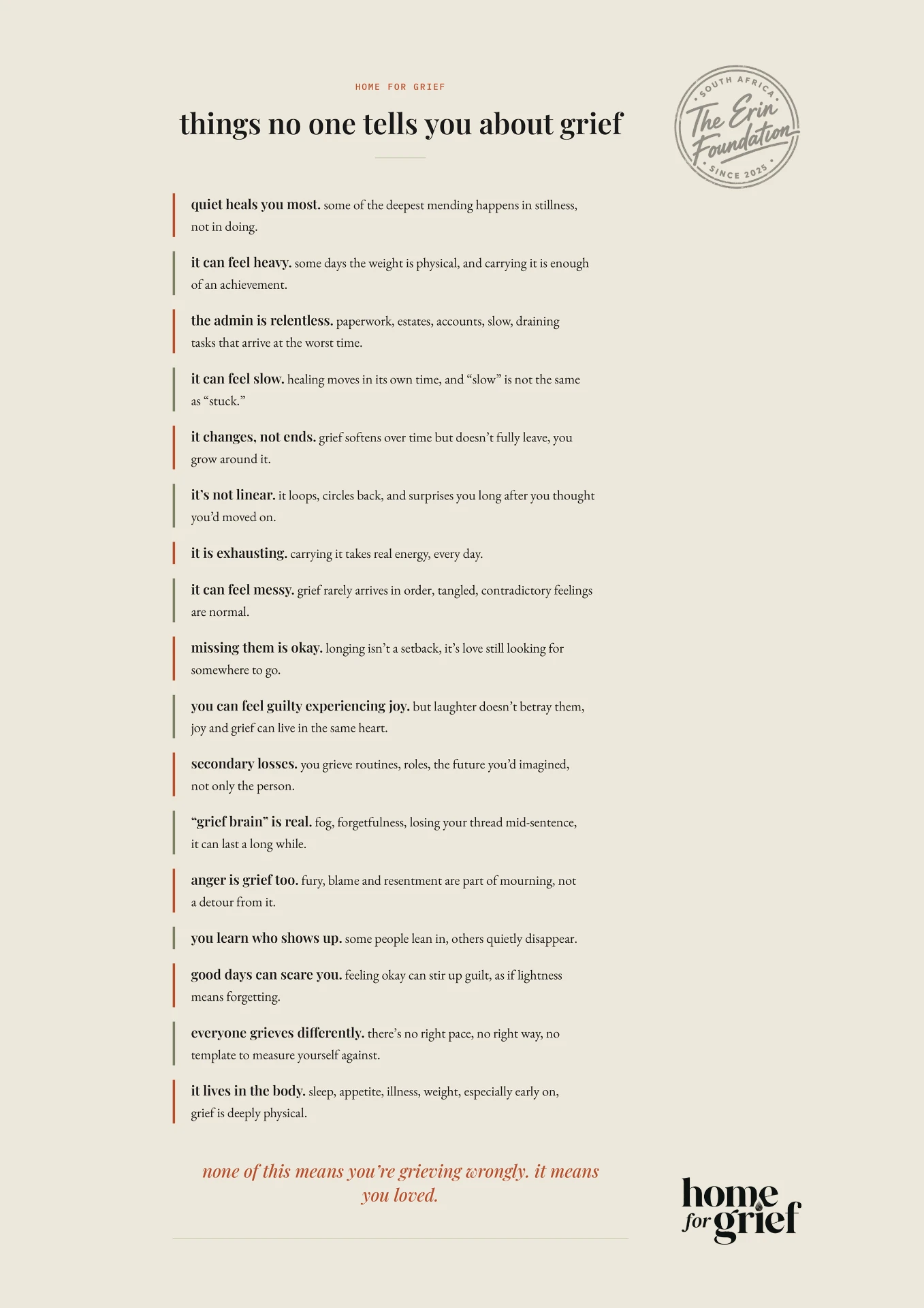
An infographic titled 'Things no one tells you about grief,' from Home for Grief, arranged as speech bubbles. It can feel heavy, slow, and messy, and it is not linear, it loops and circles back long after you thought you'd moved on. It is exhausting and lives in the body, affecting sleep, appetite and health. 'Grief brain' (fog and forgetfulness) is real and can last a long while. Anger is part of mourning, not a detour from it. You grieve secondary losses too: routines, roles, and the future you imagined, not only the person. Missing them is love still looking for somewhere to go, and you can feel guilty experiencing joy, though laughter does not betray them. Everyone grieves differently, with no right pace. You learn who shows up. Quiet heals you most, and grief changes rather than ends, you grow around it. The admin of death is relentless. None of this means you're grieving wrongly. It means you loved.

From the library

Questions others have asked. Shared in the hope that they might help you too.

Gathering…

For practitioners

Are you a counsellor or therapist who would like to walk alongside us?

If you are a counsellor, therapist or companion who holds space for the bereaved, and you feel drawn to the work of the Erin Foundation, we would love to hear from you. Reach out and introduce yourself, and we will find a time to talk.

Contact the foundation

Vintage yellow rotary telephone, reach out